Autosomal Dominant Polycystic Kidney Disease
WHAT YOU NEED TO KNOW:
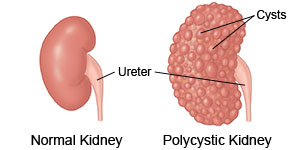
What is autosomal dominant polycystic kidney disease? Autosomal dominant polycystic kidney disease (ADPKD) is a condition that causes many cysts to grow in your kidneys. ADPKD is most often caused by damaged genes, which are inherited from a parent. The cysts may become large and damage your kidneys. When damage occurs, your kidneys may not work properly, or may stop working completely.
What are the signs and symptoms of ADPKD? You may feel no symptoms during the early stages of ADPKD. Symptoms usually begin between the ages of 30 to 40 years, but may also occur during childhood.
-
A large mass in your abdomen may develop. This mass may be caused by large cysts in your kidney.
-
Blood in your urine may occur if you have bleeding cysts or a kidney stone. When this happens, your urine may look dark brown or red.
-
Pain in your back and sides may occur if you have bleeding cysts, infections, or kidney stones.
-
You may urinate more than usual if you have urinary tract problems, such as a urinary tract infection (UTI).
What problems may be caused by ADPKD?
-
High blood pressure usually occurs with ADPKD between the ages of 20 and 30. High blood pressure may make your heart work harder and cause it to become larger than it should. High blood pressure also decreases blood flow to your kidneys.
-
Aneurysms are bulges in the walls of your blood vessels. Aneurysms may weaken your blood vessel, and it may rupture. You may also be at an increased risk of a brain aneurysm because of ADPKD.
-
Diverticulosis is a condition in which you have small pouches that bulge into your colon. You may have pain in your abdomen or changes in your bowel movements with diverticulosis.
-
Cysts in other organs , such as your liver, pancreas, and thyroid gland may develop.
-
Heart problems may develop, such as heart valve damage. When your heart valves are damaged, you may feel like you have pounding heartbeats. You may also have trouble breathing.
-
Hyperlipidemia is an increase in the amount of cholesterol in your blood. Most people with ADPKD have increased cholesterol levels.
-
Urinary tract infections occur often in people with ADPKD.
How is ADPKD diagnosed? Tell your healthcare provider if you have family members with ADPKD. He or she may ask what symptoms you feel, when they appeared, and how bad they are. He or she may use any of the following to diagnose ADPKD:
-
Blood and urine tests may be done to give healthcare providers information about how your kidneys are working.
-
An ultrasound uses sound waves to show pictures on a monitor. An ultrasound may be done to show if you have a kidney stone, cysts, or other kidney problems.
-
A CT or MRI scan may be used to take pictures of your kidneys or to check other organs for cysts. The pictures may show the size and amount of cysts you have. You may be given a dye before the pictures are taken to help healthcare providers see the pictures better. Tell the healthcare provider if you have ever had an allergic reaction to contrast dye. Do not enter the MRI room with anything metal. Metal can cause serious injury. Tell the healthcare provider if you have any metal in or on your body.
-
A renal angiography uses x-rays to take pictures of the blood vessels in your kidneys. Before the x-ray, a catheter (long, thin, bendable tube) is inserted into a blood vessel in your groin. Dye is put into the catheter, and x-rays are taken as the dye goes to your kidneys. The dye helps the blood vessels show up better on the x-ray pictures. Tell the healthcare provider if you have ever had an allergic reaction to contrast dye.
-
Genetic testing is done to see if your ADPKD is caused by damaged genes. Genetic testing may also be done if imaging tests do not provide enough information to diagnose ADPKD.
How is ADPKD treated? Currently there is no cure for ADPKD. Treatment may help decrease symptoms and slow the progress of your ADPKD. You may need one or more of the following:
-
Medicines:
-
Blood pressure medicines are used to keep your blood pressure normal. This may help decrease or prevent more damage to your kidneys.
-
Antibiotics may be given to help treat infections caused by bacteria if you have a UTI.
-
Cholesterol medicines are given to help lower the amount of cholesterol in your blood.
-
Pain medicines may be recommended. This may include over-the-counter or prescription pain medicine. Ask your provider what pain medicine is best for you. Some pain medicines may be harmful to your kidneys.
-
A special diet may be recommended to help slow the progress of your disease. You may need to limit protein and sodium (salt). Ask your provider about these and any other diet changes you need to make.
-
Aspiration is a procedure that is done to shrink your cysts. A long, thin needle is carefully pushed through your skin to reach your kidneys. Your healthcare provider will use a syringe to drain fluid from your cysts. Aspiration may decrease any pain you are feeling in your back and sides.
-
Dialysis is a procedure done to remove extra water, wastes, and harmful chemicals from your blood. You may need dialysis when your kidneys do not work properly, or stop working completely.
-
Nephrectomy is surgery to remove a kidney. A nephrectomy may be done if your enlarged kidney is causing pain. It may also be done if you will be getting a kidney transplant.
-
Kidney transplantation is surgery to replace your damaged kidney with a healthy kidney. The healthy kidney will come from a donor.
When should I contact my healthcare provider?
- You are female and know or think you are pregnant.
- You feel full after eating only a small amount of food, or you have a decreased appetite.
- You have a fever.
- You have pain in your back and sides.
- You have pain when you urinate.
- You have questions or concerns about your condition or care.
When should I seek immediate care or call 911?
-
You have any of the following signs of a stroke:
- Numbness or drooping on one side of your face
- Weakness in an arm or leg
- Confusion or difficulty speaking
- Dizziness, a severe headache, or vision loss
- You have chest pain or shortness of breath.
- You have a very bad headache, or you have frequent headaches.
- You have swelling in any part of your body.
- You have pain in your abdomen.
- You have yellowing of your eyes or skin.
- You see blood in your urine.
CARE AGREEMENT:
You have the right to help plan your care. Learn about your health condition and how it may be treated. Discuss treatment options with your healthcare providers to decide what care you want to receive. You always have the right to refuse treatment. The above information is an educational aid only. It is not intended as medical advice for individual conditions or treatments. Talk to your doctor, nurse or pharmacist before following any medical regimen to see if it is safe and effective for you.© Copyright Merative 2023 Information is for End User's use only and may not be sold, redistributed or otherwise used for commercial purposes.